
Draft v0.2 · OPM-Services, LLC website · for Stephen's review · Nov 7, 2026
Broadcast & AV Systems Integration · San Diego

Elegant systems, designed around your vision.

OPM-Services, LLC designs, builds and delivers broadcast and audio-visual systems for television stations, houses of worship, production and post facilities, academic institutions and telecommunications entities throughout the world — systems that meet today's needs and adapt easily to tomorrow's technology.

1996Founded — from TV Magic to OPM-Services
400+Completed broadcast & AV projects
5Phase design/build process, client-approved at every gate
30+Years in every corner of the broadcast industry
Trusted by CBSFOXWarner Bros.ESPNTelevisaJAXATBNCrystal Cathedral
Who we serve

One integrator for broadcast, production and presentation.

Our engineering and support staff bring multi-disciplined experience across AV, broadcast, IT, project management, service and business — so every project gets a comprehensive, integrated analysis of its features and components.

Television stationsMaster control, news, production, transmission
Houses of worshipIMAG, broadcast, volunteer-friendly control
Production & postStudios, edit suites, audio rooms, storage
Academic institutionsClassrooms, auditoriums, lecture capture
TelecommunicationsNetwork operations, distribution, worldwide
About OPM-Services

Ethics, integrity and complete honesty as our compass.

In 1996, Stephen D. Rosen founded TV Magic — and then OPM-Services, LLC — to help broadcast engineers meet the challenges of rapidly changing technology. The principles haven't changed: open, honest relationships built on what you need and want, and technology choices that maximize your return on investment.

Today, OPM-Services, LLC is a respected systems integrator. We approach each project and customer relationship with a focus on identifying your needs, priorities and preferences to provide elegant systems and workflow solutions that are within your budget and delivered on time.

We believe it is critical that you understand not only what you can do with your system, but what you cannot do based on budget, equipment requests and desires. Our approach guarantees your expectations are clearly defined, monitored and executed throughout your project — providing ongoing value engineering for cost and quality, and a final deliverable that meets all of your technical and financial requirements.

We make it a priority to:

1
Listen

to what your objectives are, and stay focused on those objectives throughout our design process.

2
Evaluate

a working system design to determine what may be redundant in features and functionality, and which equipment will provide a better system solution.

3
Recommend

once redundancies or cost-effective technical substitutions are identified, we bring our findings to you with our technical recommendations.

4
Collaborate

after presenting all of the information, we work with you to select equipment that meets your business objectives and deliver a system that does what you need it to do.

No steps, designs or equipment types are assumed — client acceptance is required to continue through each stage of the design/build process.

Quality assurance

Processes that keep every project — small or large — at the highest quality.

Design reviews

An Initial Design Review and a Critical Design Review for Phases I and II. An engineering manager reviews scope documents, timelines and block and flow diagrams before anything is presented to you — so your project draws on the whole engineering team.

Installation standards

Each project has a crew chief who drives the crew to the timeline and enforces OPM standards for mechanical installation, cable termination and dress. A project engineer joins as systems come alive, resolving issues quickly with the design engineer.

Tracking & sign-off

Hours are tracked weekly in every phase and compared to estimates. Wrap-up meetings capture lessons learned, and a project sign-off form records your agreement that each phase is complete to your satisfaction.

AV Consulting

Why bring in a systems integrator?

Broadcasters often have engineering staff in place; AV teams and non-profits watch every dollar. Both ask the same question — "why do I need an SI?" A competent integrator makes design/build more cost-effective, not less. Here's why.

Impartial evaluation

We're hired for expertise, not politics. We'll tell you when we disagree — and why — so you get the most efficient facility, not a yes-man's version of it.

Frees your in-house team

Your engineers and operators are not full-time system designers. Let them run the facility while we carry the design, so daily operations never get thrown off kilter.

An outside view

After hundreds of projects across industries, we've seen how technologies combine in unexpected ways. That perspective is what you're really paying for.

Manufacturer relationships

We track the products, providers and technologies entering and leaving the market — and we offer multiple equipment options, objectively, regardless of whom we represent.

Accountability

Our name is tied to your project. A single point of contact, backed by an expanded team of specialists from each vendor, with a vested interest in your success.

Flexibility

Manufacturers are limited to their own technology. We're not — we present options alongside a benefit analysis.

Software & controls

Real-time system information, automation and control surfaces designed around how your people actually work.

Strong engineering

Commissioning is the hardest part of any start-up. Problem-solvers who "make it happen" bring the system up fastest.

Reduced workload

Vertical and horizontal integration planned from day one, so every area of the facility talks to every other.

Value engineering

The lowest cost is not always the best value.

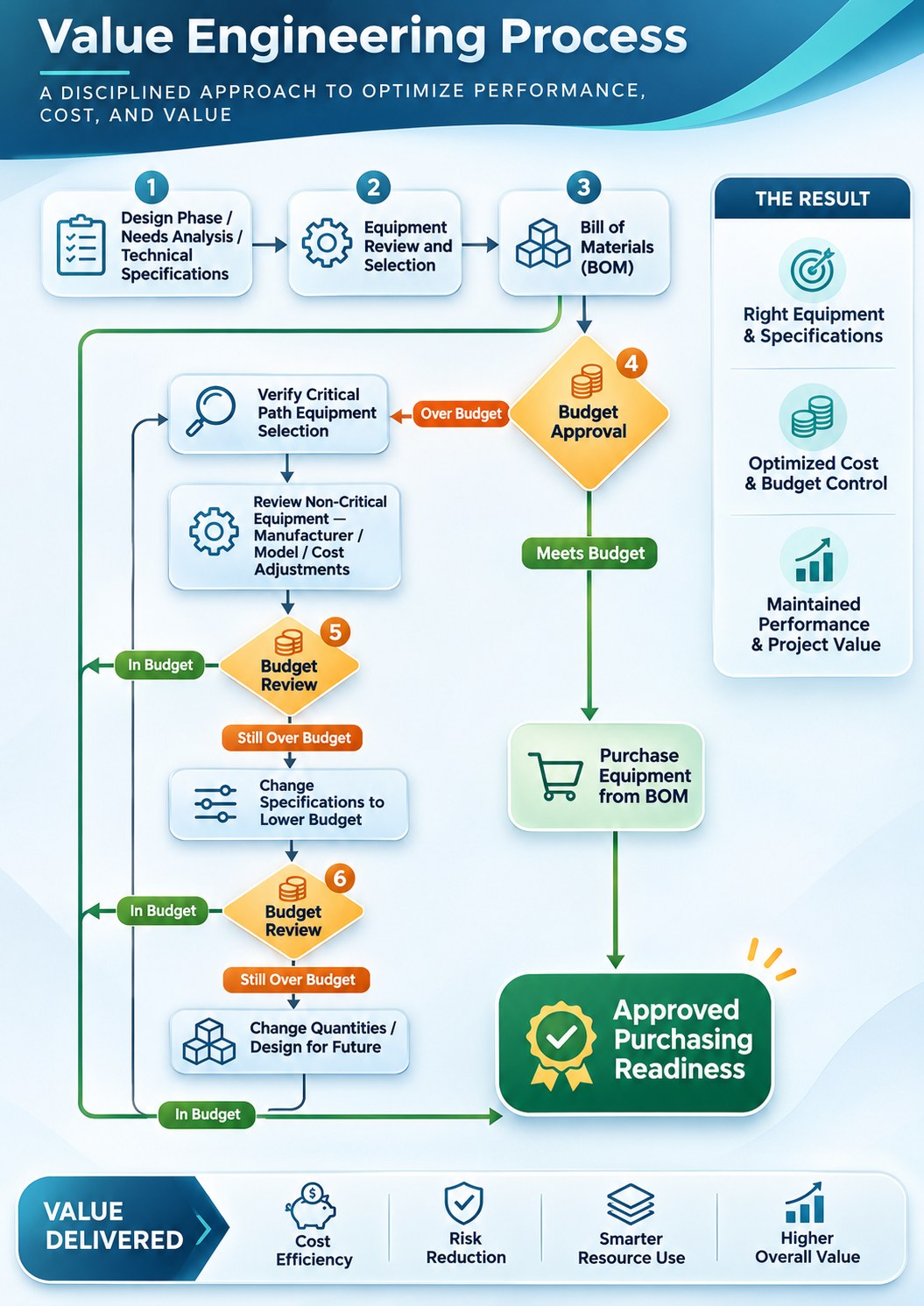
Every system is unique and most budgets are narrow. As we define the technical and operational aspects of your system, we develop specifications, select products that meet them — weighing reputation, market history, technology and availability — and build a Bill of Materials. If the BOM exceeds your equipment budget, value engineering begins:

  1. Protect the critical path. Verify the signal chain that most affects the final product (camera → switcher → server → air) keeps its best-value equipment.
  2. Substitute in the non-critical path. Identify lower-cost products that still meet the original specification — presented in writing, with justification and any benefit lost.
  3. Revisit specifications. If still over budget, evaluate reduced specifications for non-critical items, with the trade-offs presented for your approval.
  4. Design for the future. If necessary, design to the ultimate quantity but purchase fewer now — built for "plug and play" additions when new budgets allow.
Value Engineering Process: design phase and needs analysis, equipment review and selection, bill of materials, then budget approval; if over budget, verify critical-path equipment, review non-critical equipment, change specifications, change quantities or design for the future until in budget, then purchase from the BOM. Results: right equipment, optimized cost, maintained performance.
Value Engineering Process — click to enlarge
System design considerations

Design/build is never as simple as it seems.

Every one of these systems must be addressed, determined relevant to your project, then researched, designed for and integrated. We consult with you to build the equipment list around production style, workflow, budget, technical specifications and local operational experience.

Video & cameras
Audio & intercom
Routing & distribution
Control & automation
IT & networking
Storage & archive
Timing & sync
Monitoring & multiviewers
Electrical loads
HVAC & mechanical
Racks & consoles
Documentation & CAD

Please note: OPM-Services, LLC is not an electrical, mechanical or HVAC contractor and does not provide architectural drawings. We provide conceptual drawings and specifications for evaluation by your architect and licensed engineers.

Software Consulting

Software built by people who run broadcast operations.

Alongside systems integration, OPM-Services designs and builds software for media, sports and advertising workflows — multiplatform applications for mobile, web and desktop, backed by three granted U.S. patents.

The PhotoTag app icon: a blue camera with a purple tag attached
Coming soon · App Store & Google Play

PhotoTag

Your calendar, in every photo.

PhotoTag writes the details of your calendar event (its name, description, keywords and place) into the photos you take, as standard tags that common photo tools can read. Take a picture during an event (a trip, a hike, a wedding, a site visit) and the photo carries those details in the file itself.

Private by design: no account, no ads, no tracking. PhotoTag does its work on your phone, and we never see your photos or your calendar.

  • Photos and videos taken in the app are named after the event and numbered in order.
  • Events nest: a morning’s snorkeling inside a week-long trip? Photos taken then carry both.
  • Took them with your regular camera? Tag afterward saves tagged copies. Your originals are not changed.
  • Speak a note, and the words are written into the next photo.
  • Videos get a standard companion file with the same details. The video file itself is not changed.
Athelytix — Precision Sports AnalyticsThe Grid

Athelytix

Transforming sports through precision performance analytics.

Athelytix built The Grid™, a multifaceted platform combining patented beam-interrupt laser technology with proprietary software to capture high-precision performance data. It serves athletes, coaches and sports organizations from high school to the pros — measuring performance and biomechanics, supporting scouting and recruiting, powering fan-engagement experiences and opening retail and revenue opportunities. OPM-Services designed and built the software behind it.

The Grid™ platformBiomechanicsScoutingFan engagement
Viper Integration Services & Cabling

eViper Business Suite

From GO / NO-GO to signed quote, in one dashboard.

A custom-built business suite for Viper Integration Services & Cabling. Every opportunity starts with a GO / NO-GO evaluation; on a GO, the purpose-built Estimator prices the job and the Quote module turns it into a proposal. The dashboard also includes a custom CRM and a social-media creation studio that drafts and schedules posts for Facebook, Instagram and LinkedIn.

GO / NO-GOEstimatorQuoteCRMSocial studio

Ad Agency Station Traffic System

Draft copy — Stephen to confirm. Traffic and scheduling system connecting ad agencies with television stations — orders, spot placement, logs, affidavits and billing in one workflow, drawn from decades of running network traffic and programming.

Traffic & schedulingAgency ↔ stationBilling

Have a workflow that off-the-shelf software doesn't fit? Tell us about it — we scope, design and build to the same five-phase discipline we use for facilities.

Design / Build

A proven five-phase process — nothing purchased until you approve.

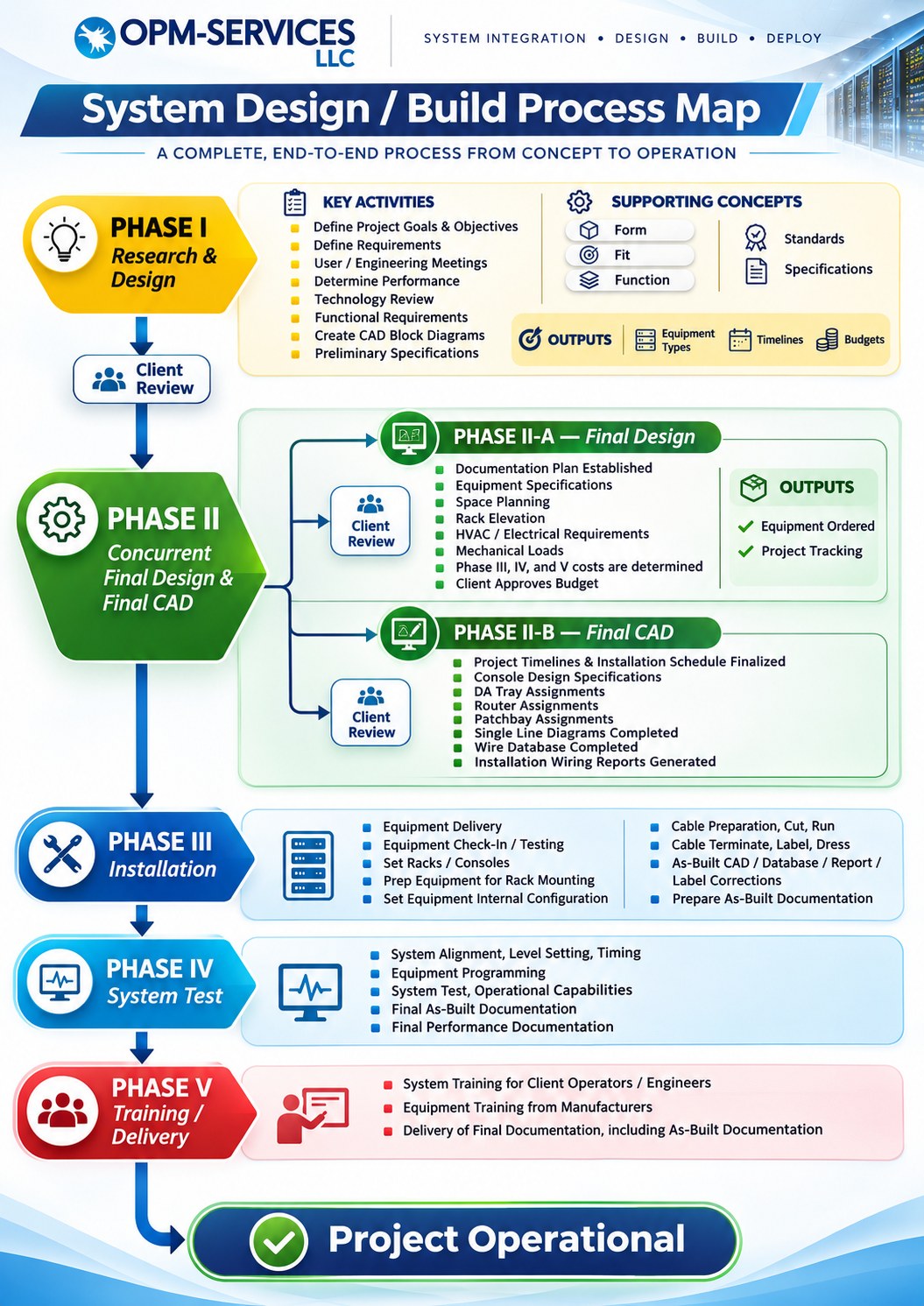
"Design/build" and "value engineering" are easy to say. Without a time-tested road map, projects slide off schedule and over budget. OPM-Services consistently uses one proven five-phase process. Each phase has required deliverables; each ends with your review and approval before the next begins.

Phase I

Research & Design

Goals, requirements, form-fit-function, performance standards, block diagrams, preliminary equipment list and budgets.

Phase II

Final Design & CAD

Concurrent final design (II-A) and final CAD (II-B): BOM, rack elevations, loads, wire diagrams, database, schedule — budget approved.

Phase III

Installation

Equipment check-in, racks and consoles set, cable cut, run, terminated, labeled and dressed; as-built corrections.

Phase IV

System Test

Alignment, level setting and timing, programming, proof of performance, punch list, final performance documentation.

Phase V

Training & Delivery

Operator and engineer training, manufacturer training, delivery of as-built CAD and all final documentation.

Client review and approval gates every phase — and the facility is Project Operational at the end of Phase V.

Phase I — Research and Design▾

It is in Phase I that the exact requirements and constraints of the system are defined. All subsequent phases refine and execute the specifications developed collaboratively with you here. We also recognize that you may have pre-purchased or existing equipment — we'll integrate it properly with everything new.

  • Define requirements of form, fit and function
  • Define system performance standards and specifications
  • User / engineering meetings and technology review
  • Conceptual block diagrams and signal flows to your approved functional requirements
  • Preliminary equipment list — type and manufacturer
  • Short- and long-term operations strategies
  • Preliminary project timelines and installation schedules
  • Preliminary budgets, including estimates for Phases II–V
Phase II — Finalize Configuration (II-A Final Design · II-B Final CAD)▾

Phase II refines the Phase I findings into an executable plan for single-line wiring and mechanical work. Budgets are prepared with specific line-item equipment lists, purchasing is set in place, and timelines are finalized. Rack elevations, floor plans and a cable database are produced and prepared for installation.

  • Documentation plan established; equipment specifications
  • Bill of Materials (make, model, quantities) and budgets documented
  • Phase III, IV and V costs determined — client approves all budgets
  • Space planning and rack elevations finalized
  • HVAC / electrical load requirements provided to your engineers
  • Equipment ordered; project tracking begins
  • Console design specifications; DA tray, router and patchbay assignments
  • Single-line CAD diagrams, wire database and installation wiring reports
  • Project timelines and installation schedule finalized
Phase III — Installation▾

Equipment is ordered and deliveries arrive. Your construction and build-out should be complete, dust-free and ready — electrical and HVAC installed and operational. OPM maintains supervisory authority for installation, selects and procures all installation materials, follows all local, state and federal rules and broadcast standards, and adheres to good engineering practice throughout.

  • Equipment delivery, check-in and testing
  • Racks and consoles set; equipment prepped for rack mounting
  • Equipment internal configuration set
  • Cables prepared, cut, run, terminated, labeled and dressed
  • Disposal / storage of packing material
  • As-built CAD, database, reports and labels corrected for last-minute changes
  • Equipment manuals categorized and bound; technical procedures documented
Phase IV — System Testing▾

System configuration, testing, proof-of-performance and alignment after all equipment is installed — to the performance specifications defined in Phase I and finalized in Phase II. When Phase IV is complete, the facility is fully operational.

  • System test and operational capabilities
  • Alignment of distribution amplifiers, level setting and timing adjustments
  • Equipment programming and setup
  • Completion of all punch-list items
  • Final as-built and performance documentation
Phase V — Training and Delivery▾

Delivery of the completed, fully operational system. You review all final documentation and operational specifications; Phase V — and the project — is complete upon delivery of the final documentation and drawings.

  • System training for your designated operators and engineers
  • Coordination of specialized equipment training by manufacturers
  • Delivery of all final documentation and as-built CAD drawings
  • Delivery of final technical procedural documentation
OPM-Services System Design / Build Process Map showing Phases I through V with client review gates and the deliverables of each phase, ending in Project Operational.
System Design / Build Process Map — click to enlarge
Project management

Managed to PMBOK best practices, from kickoff to sign-off.

Management plans are created at the start and adhered to for the duration of the project. Weekly reporting of actual progress against the master schedule, standardized document revision control with a shared document site for your review, daily on-site quality control, and written records of every issue and its resolution.

Staffing & resourcesScheduleDesign & implementationDocumentsQualityEquipment & materialsCommunicationsIssuesChange orders
Projects

Selected work.

From one of the largest broadcast builds in the country to volunteer-run worship systems and classrooms — each designed, project-managed and installed by OPM-Services. Select a project to read the case study.

Los Angeles, California

ESPN — LA Live!

ESPN is a worldwide leader in live broadcast and distribution of comprehensive sports coverage on-air, online and on mobile. Its west-coast facility is one of the major buildings within LA Live in downtown Los Angeles, across the street from the Staples Center. Home of SportsCenter, the nearly 12,000 square foot studio includes two master control rooms, eight edit suites, three production control rooms, a newsroom, screening area, music room and voice-over room for two studios.

OPM-Services designed, project-managed and installed this massive 16-room endeavor. As a pioneer in integrating the newest technology, one of ESPN's LA studios became the first completely 1080p production facility. At the time, LA Live was one of the largest undertakings in the country, with over 23,600 cables pulled. Major new equipment included a Sony MVS-8000G switcher, Calrec Sigma audio console and Quantel editing systems. The venue broadcasts on ESPN, ESPN2, ESPN HD, ESPN2 HD and ESPN Deportes.

16 roomsFirst full 1080p plant23,600+ cablesSony MVS-8000GCalrec SigmaQuantel
Los Angeles · Houston · Detroit

FOX Sports Network

When FSN West moved from the Staples Center to a downtown location, the network took on the challenge of launching a new, state-of-the-art FSN West facility while upgrading regional facilities in Houston and Detroit — all three with HD production and transmission. FOX Sports contracted OPM-Services to design and install FSN West first, then build the regional facilities on a smaller scale to similar design criteria, in time for the Houston Texans' 2009 NFL season and the Detroit Red Wings' 2009 NHL preseason.

All three designs included Ross switchers, Evertz routers and Avid edit systems, though differences in workflow made a single footprint impossible. The FSN West blueprint established a baseline for every future upgrade. OPM-Services streamlined the design timeline to hit every goal: FSN West went live in August 2009 for the end of the MLB season, Houston for the Texans' NFL opener, and Detroit in October 2009 for a Red Wings exhibition game live from Sweden.

3 HD facilitiesRossEvertzAvidOn air for the 2009 season
Hendersonville, Tennessee

Trinity Broadcasting Network — Trinity Music City

Broadcast Engineering 10th Annual Excellence Awards Runner-UpBroadcast Engineering 10th Annual Excellence Awards — Runner-up

TBN, the world's largest religious network, has been converting its large production facilities from SD to HD. Trinity Music City required a system that would produce high-quality HD family entertainment, change between setups at the touch of a button, and be the first TBN facility to go tapeless. The design was meticulously planned for nearly three years; rooms were reconfigured to accommodate crews of up to 20 technicians, yet flip quickly to small productions of four — serving in-house productions and outside producers alike. The result: the most flexible control rooms in the broadcast industry.

One of the facility's greatest innovations is the "sliding switcher." For simple productions the director acts as technical director with the switcher at the center of the console; for complex productions the switcher moves to the far right for a TD, with the director seated at center. Working with Laguna Designs, OPM-Services built a console whose switcher control panel physically slides to the desired configuration.

SD → HDFirst tapeless TBN facilitySliding switcher console4 to 20 person crews
Orlando, Florida

Trinity Broadcasting Network — WHLV-TV

When developing the Holy Land Experience theme park in Orlando, TBN hired OPM-Services to build a broadcast center that could act both as a local TBN affiliate and as a live HD production center originating park presentations for the rest of the network.

To keep costs down, OPM-Services chose an Evertz EQX 288×288 router frame that accepts fiber from the park and coaxial sources from production control and satellite directly, with built-in display processors for the multiviewers. Up to eight Ikegami cameras connect from the park over buried fiber through strategically located interconnect panels. The innovative audio production room features a Studer Vista 9 mixer serving as the station's central digital audio router — controlled by Evertz video router panels — with an Avid Pro Tools position for editing and sweetening. Custom Laguna Designs furniture and two Final Cut Pro workstations complete the facility.

Evertz EQX 288×288Studer Vista 98 Ikegami cameras over fiberAffiliate + HD production hub
Las Vegas, Nevada

Word of Life Christian Center

Word of Life upgraded an analog, standard-definition control room to a digital HD production system including SAN, archive, digital signage, IMAG and facility presentation. The system had to be easy for volunteers to operate and scalable for growth, with mobile, extremely simple control of IMAG and signage.

OPM-Services built a reliable system with redundant video playback while integrating a significant amount of existing customer-furnished equipment, and merged two separate systems — "Production" and "Presentation" — into one cohesive, powerful and user-friendly whole. Mission-critical displays have independent access to both systems for redundancy. The production audio was integrated with the existing front-of-house console so volunteers move between the two without retraining. A PTZ "whole house" camera and a roaming shoulder-mount camera plug into ten SMPTE fiber locations in and around the sanctuary.

SD → HDProduction + presentation unifiedVolunteer-friendly10 SMPTE fiber positions
Anaheim, California

Tiger Woods Learning Center

The Tiger Woods Learning Center is an innovative youth-education facility providing fifth- to 12th-grade students with enrichment in reading, math, science and technology on a 14-acre campus. TWLC commissioned OPM-Services to design, build and install AV systems for classrooms and an auditorium, working with the center and its architect to ensure an optimal teaching and learning environment.

The installation covered the auditorium, seven classrooms and a boardroom. Classrooms and boardroom are equipped with projectors, screens and sound. The 230-seat auditorium features surround sound, a custom 20 × 12 ft Stewart screen, Polycom videoconferencing, AMX control, a Sanyo projector and JBL speakers, with floor boxes for camera setup at events. "OPM-Services helped equip us with the technology to successfully teach our innovative curriculum," said executive director Kathy Bihr. "The surround sound and movie theater-style screen in the auditorium have been instrumental in providing effective community workshops and lectures."

230-seat auditorium7 classrooms + boardroomAMX controlPolycom VCStewart 20×12 screen
Value Engineering Process System Design / Build Process Map
Contact

Let's talk about your facility.

Tell us about the project — a new build, an HD or IP upgrade, a worship or classroom system — and we'll start with Phase I: listening.

Corporate addressOPM-Services, LLC
10333 Avenida Magnifica
San Diego, CA 92131

What to have ready

  • Rooms and functions you want covered
  • Existing or pre-purchased equipment
  • Target dates and any hard deadlines
  • A budget range, even a rough one
Draft only: this form does not send yet. Wire it to a form service or endpoint before launch.
↑